Thursday, March 11, 2021

Blog #5


  • Select 3 Things you have learned this quarter and describe how your thoughts changed, developed, or were reinforced by our course work. Be sure to connect to readings and/or class discussions.

Our class is a family.

    1. One of the most important lessons I learned this quarter was that if you put enough work into your preventative strategies and create a sense of community, you will have many many fewer corrective stage problems to deal with. 

    2. I learned that fostering a sense of community and allowing those students that need space an outlet will help stop behaviors before they happen. Classroom design is a huge part of classroom management and you need to be purposeful in the way that you organize, decorate and allocate space. 


       3. I also really like the verbal and non-verbal ways we can communicate with students. I though it was very important that you encouraged us not to use name dropping, our goal should never be to out our children or catch them up, that's really counter productive. Also names hold power and really are best used along with praise or encouragement. 

  • Identify one challenge/concern/question you still have about classroom management. Explain your thoughts about this issue.
    I guess that a concern of mine is about rewards still. I understand the reasons why they are damaging at times, and actually ineffective in a lot of respects. I love the idea of celebrations, but am also wondering how you separate them from the concept of rewards if a celebration is still won with hard work. Is it just that it's random and not a guarantee. 


Thursday, February 25, 2021

Blog #4

  • If there is one thing that seems consistent across elementary classrooms everywhere, it is the pervasive use of reward systems. How do you plan to use them? If not at all, why not? If some, how? If you plan to use them a lot, what is your evidence for why that is the best plan?
I plan on using the ones that the school implement, I know that the school I volunteer at uses "bear paws," when a teacher sees a student doing something good, they give one to them, at the end of the week, they announce the students in each class that earned the most. I know they also do "pizza parties," I will participate in the systems that the school asks me to, but in my own classroom, I think I will try not to use rewards. I think that proper classroom management will eliminate the need for them mostly. I do like the idea of a prize box, just because it was one of my favorite things when I was younger. I also really like the idea of  a "desk pet," but I would like to do these things for fun rather than as incentive for good behavior. I hope that the relationship I build with my students is strong enough that they want to behave for me, although that seems somewhat naïve I'm sure. 


  • What do you think of Gus' (Kovalik's) idea of a set of powerful vocabulary like the LifeSkills? Do you think you will use something like that in your classroom? Why or why not? 
I loved the idea of lifeskills. I think it's important for us to teach our children and students what they should expect from others, and also how to treat others. I thought this was a great list and I think that most of these would show up on school rule lists. Trustworthiness, truthfulness, active listening, no put-downs, personal best! These are qualities that all people should strive for, regardless of age. My classroom rules from last blog were be kind to yourself, each other, our tools and work hard and never give up. I feel that these are totally in line with the lifeskills Kovalik outlined in the article. 


Thursday, February 4, 2021

Dislike


Like


  • What do you not like about the set of rules you selected as a poor example?
I think that the first rule is to vague, "an appropriate manner?" I do not think the language is student friendly or concise. I also dislike the use of negatives, sloppy, no excuses, don't discourage. Also, the idea of excellence only feels like it could be very discouraging to people that may be struggling. 

  • What do you like about the set of rules you selected as a good example?
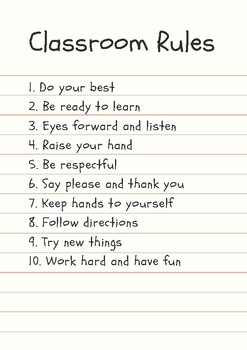
I love that the students signed their name to the rules. It adds an extra sense of ownership and inclusion. I like the positivity, we don't need perfection, we need to work hard and not give up! I love that kindness to others is brought up, but often kindness to ourselves is forgotten and that's a shame. I also think a reminder to be good to supplies doesn't ever really go amiss. These are concise, to the point, and also very relevant. Nothing about these rules should make someone feel bad, or guilty. They are also easy enough for many students to read on their own. 

  • Share a set of rules you would like to have in your classroom in the future (or ones that you hope you kids come up with if you plan to have them part of the process). Explain what you like about these rules.
Honestly I think the list I chose is wonderful, I would maybe add *Be Safe. I think that as long as we are consciously caring about ourselves, our peers, and our surroundings, the rest should fall in place. Respect is a big concept, it is a lot to process and has many aspects. Kindness is a much more understandable and relatable concept in my opinion. I think that most behaviors in class could be dealt with by pointing to one of these rules. If a child is not sharing, "are we being kind?" If a child is running "is that safe?" If a child is hitting someone with their backpack, "are we being kind to our supplies and our friends?" I'm really happy with that list I found, I plan on using it in the future!


Sunday, January 31, 2021

Blog #2


Many teachers who believe in student-centered learning struggle to give up teacher-centered management. What do you think about Garrett's premise? Why do you think teachers struggle with this? 

I think one of the biggest struggles I can see has to do with time-management. Having many student-led or student-centered activities can take time. Allowing students to take their time and really dig into their own learning can be time consuming. On the other hand, having children self-manage their behavior, can take time as well. If you allow students to be in charge of their own behaviors and classroom management, I can see the worry that it will cut into academic time being a valid one. I think it may be a struggle for some teachers as well because they may begin to question their role if they aren't necessary for management and learning. I think that our main function as a teacher is to be a guide, and really to present information and questions and let their brains get to work. 

Where is your "sweet-spot" on the continuum? Why do you believe that location is the best fit for you?

I know that my spot is similar to Gus's, but I am just fine with that! I think that his classes are usually very student led, with lots of opportunities for collaboration, but also there is plenty of guidance. I want the students to learn from me, and know that learning from their teacher is important, but I also want them to understand that really, we all learn together! I believe that some of the best learning comes from authentic interactions, whether that be teacher/class, student/student. or teacher/student. I love the idea of letting students know that we are a unit, and as such, we learn together. When I make a mistake, I am the first to say "I learned something new!" I hope that my students learn to love that phrase too, and we approach new challenges together. 


Thursday, January 14, 2021

Blog #1

  • How are your initial thoughts about management already changing or being reinforced?
I’ll be completely honest, this is one of the aspects of teaching that intimidates me most. I see how my daughter’s teachers manage their classrooms, and the video observations, as well as my childcare experience, and it still seems like such a difficult task, at least to do well. I really enjoyed the 3 principles of classroom management that we read about and discussed. I think that personal responsibility is such an important concept for children and really, if we can teach children how to manage their own behavior, there is so much less work involved for us as the teacher. 
  • How do Charles' three purposes for management (he calls it classroom discipline) complement each other? 
I think that when they are all taught together, they effectively take the work off the teacher’s shoulders. Students learn that they have choices and their voice is important, they also learn that they choose their behavior and are responsible for those choices. That sense of ownership really makes children feel more involved. 
  • Which authority base are you most attracted to? Why that one?
I would say the referent authority. I do want students to know that I am rooting for them, that I care, and I understand that we cannot be “friends,” but I do want them to have that security that I am on their team. I want them to manage themselves because they want to, because they know that it’s in their best interest and I ask them to do the things I do because it’s for them, not just for me. I feel like this base is the closest to how I want to approach my classroom management. 

Blog #5

  Select 3 Things you have learned this quarter and describe how your thoughts changed, developed, or were reinforced by our course work. Be...